
Search Scottsdale Residents Directory
No agency keeps a complete Scottsdale household roll. The useful path depends on whether the starting clue is a name, a current address, an old address, or a date. Maricopa County owns most land and court indexes. Scottsdale keeps city permits, planning cases, court records, and local archives. Arizona offices control vital records, statewide courts, business filings, licenses, and protected-address programs. The best result comes from matching two strong records created for different reasons.
A parcel can prove ownership but not occupancy. A voter check can confirm a person's own registration but cannot be browsed as a public street roll. A deed names transfer parties, while a directory or census may identify likely occupants. Renters, children, guests, utility customers, and people using protected addresses may not appear at all. That limit is part of a sound search, not a portal failure.
- Start with the Maricopa County Assessor Parcel Search when a name or street address is known. Save the APN, owner wording, situs, mailing address, subdivision, and deed reference.
- Use the recorded deed number or owner name in the county document index. Match the legal description before accepting the party as the same Scottsdale person.
- Check the court level that fits the event. City, county, statewide, and federal indexes do not cover the same cases.
- For an older Scottsdale resident, move to Heritage Connection directories, yearbooks, newspapers, census tools, probate files, and public historical certificates.
- If an index stops short, contact its custodian for a terminal search, appointment, certified copy, or narrow Arizona Public Records Law request.
Scottsdale Residents Directory Offices
Scottsdale resident records sit at the government level that created them. The Recorder preserves deeds, liens, plats, releases, and other recorded instruments. The Assessor maintains the current tax roll and separates the property address from the owner's mailing address. The Recorder's elections side handles public voter-file requests, while My.Arizona.Vote serves the individual voter. Scottsdale Planning Records connects permits and plans to an address. A full street-by-street method belongs in the Scottsdale street directory; the office map below shows where each part of the chain begins.
Maricopa County Recorder
Deeds, liens, plats, releases, and voter-file requests
Permanent county record since 1871
Maricopa County Assessor
Owners, parcels, situs and mailing addresses
APN, address, name, and subdivision modes
Scottsdale Directory Assessor Clues
The Maricopa Assessor is often the quickest current lead in a Scottsdale resident search. Its owner field may contain a person, family trust, or company. Its property address is the situs, meaning the parcel's physical location. The mailing field is where tax notices go. A match between them supports an owner-occupancy theory, but does not prove who lives inside. A mismatch can reflect a seasonal owner, an investment, trust administration, or a simple mailing choice.
| Assessor field | Input form | Best use | Key caution |
|---|---|---|---|
| Search | Text with autocomplete | Parcel, owner, address, or subdivision | Choose the matching Scottsdale result |
| APN | Dashed number | Direct parcel retrieval | Use the full county identifier |
| Owner Name | Surname or entity | Find parcels held by a named owner | Try trust and spelling variants |
| Property Address | Street text | Connect a place to its parcel | It is not the owner's mailing field |
| Subdivision | Name or linked result | Open a group of Scottsdale parcels | Confirm the correct plat and lot |
The official Scottsdale-area parcel search is shown below. Its separate entry modes are more useful than a broad web name search because the result stays tied to one county parcel.
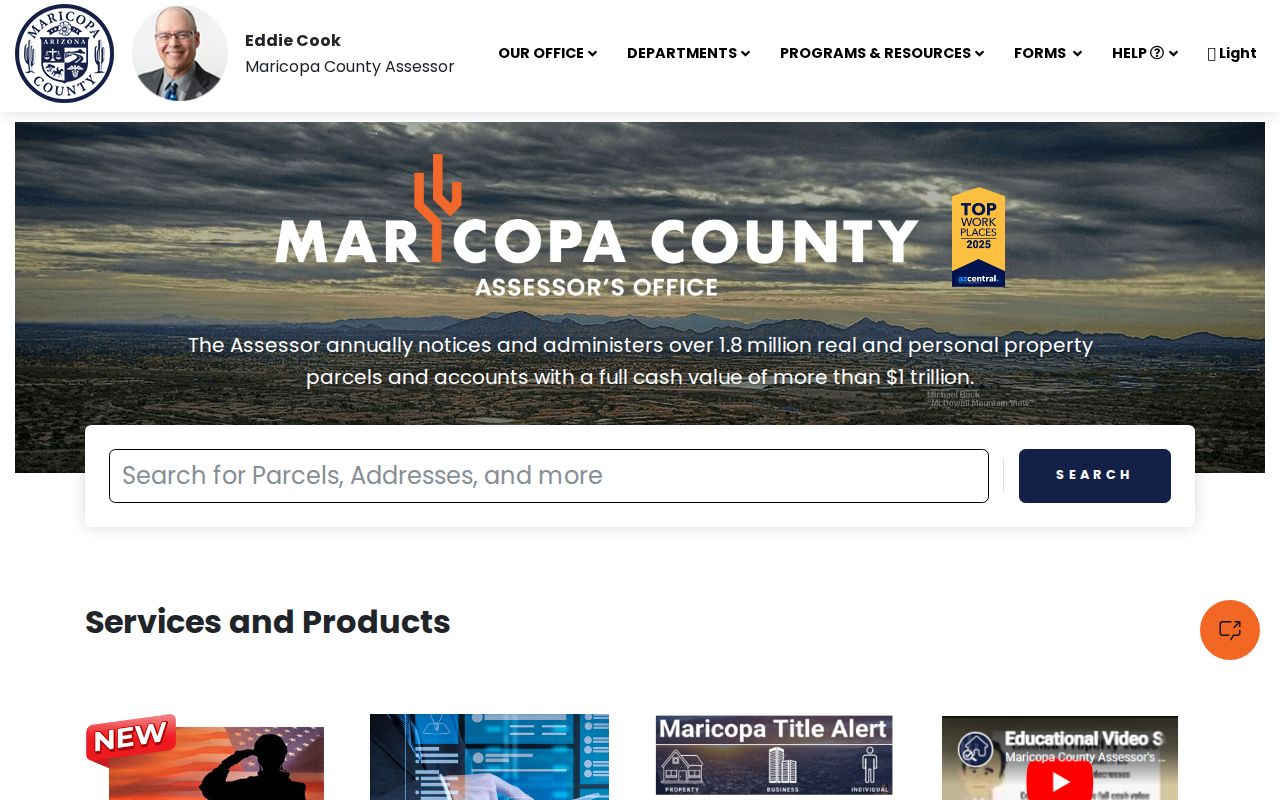
The visible parcel tools provide the APN and legal land context needed to move from a loose address clue to a deed, map, or city permit record.
Scottsdale Deeds Reach 1871
The Recorder reports more than 52 million searchable documents and a permanent public record beginning February 14, 1871. Its first deed dates to May 5 of that year. That depth gives Scottsdale researchers a long chain of named grantors and grantees. Grantor means the party transferring an interest; grantee means the party receiving it. A current owner can be searched as a grantee to find a purchase deed, then the seller can be searched as a grantee in an earlier period.
Results may show recording number and date, document type, pages, party roles, legal description data, and an image link. The image can add return address, consideration language, notarization, and the recording stamp. Yet a deed proves a transfer, not that the new owner moved into the Scottsdale property. Certified copies come from the Recorder, and in-person or written help remains the fallback when an image or index entry is absent.
Current Scottsdale Directory Sources
Current Scottsdale resident directories are really purpose-built rolls. Each answers a narrow question. The assessor links a legal owner to a parcel. The Recorder links people and entities to recorded instruments. Court systems show public case events within their own jurisdiction. Permit files place an owner, builder, or applicant at a project on a date. Voter access has a personal verification path and a separate regulated request path. Community groups may publish officers or contacts, but private member rosters do not become public merely because an association exists.
| Official source | People or parties shown | Record keeper | Access route |
|---|---|---|---|
| Parcel tax roll | Legal owners and mailing contacts | Maricopa Assessor | Free web search |
| Recorded document index | Grantors, grantees, and indexed parties | Maricopa Recorder | Online index, office copies |
| Individual voter check | The verified voter's own status | Arizona and county elections | Identity-gated portal |
| City permit records | Owners, builders, and applicants | Scottsdale Planning | Free searches, targeted request |
| Public court dockets | Parties, lawyers, events, and outcomes | City, county, or state court | Portal, clerk, or public terminal |
| Association contacts | Published officers and registered contacts | Group or city registry | Public contact only |
Someone trying to verify one Scottsdale name can follow the focused Scottsdale resident lookup workflow instead of treating every listed person as the same individual.
Scottsdale Permit Records Add Dates
Scottsdale Planning and Development adds the city layer to the resident-record trail. Its document search separates Street Number, Street Name, Type, and Unit. It can also search Case Number, Plan Check Number, Building Permit Number, Civil Permit Number, Lot Number, Parcel Number, Full Text, and selected document types. Results can sort by full address, case, permit or plan number, document name, or description. The separate permit portal accepts a permit number, address parts, subdivision, lot, owner or builder, APN, and unit.
A permit can date work and identify an applicant or builder. It does not establish a household. Certificates of occupancy, elevation certificates, site plans, and planning cases can still confirm a Scottsdale property's history. Building plans face a special limit: the city says they are destroyed 180 days after completion or expiration and remain the architect's or engineer's intellectual property. The named designer may become the best fallback for detail that the city no longer keeps.
The Scottsdale public-records gateway shows the request categories and fee policy used when self-service tools do not supply the record.
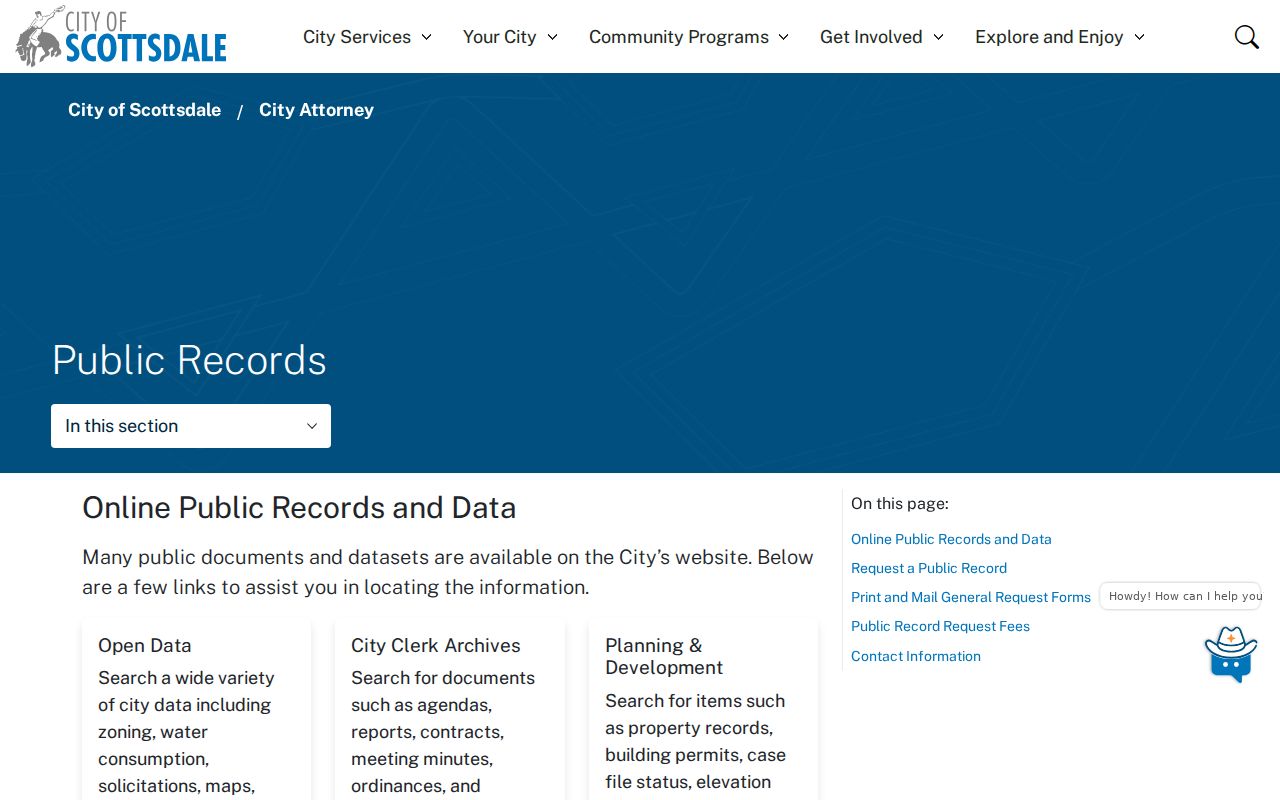
The category choices matter because a request sent to Planning, City Court, Police, Fire, or General Records follows the office that actually maintains the file.
Scottsdale Residents Across Three Courts
Scottsdale names can appear in several court systems. Scottsdale City Court handles city violations, traffic matters, and misdemeanors. Maricopa Superior Court holds major civil, criminal, family, and probate files. Arizona Public Access offers cross-court discovery for most participating courts, but Maricopa Superior Court coverage there is partial. The county docket is the stronger route for its civil, family, and probate chronology. Federal District of Arizona cases use PACER.
Public Access excludes sealed cases, protection orders, mental-health matters, probate, victim and witness data, and juvenile delinquency matters. It updates weekly and is informational rather than an official court record. The county docket can show case title and number, filing date, category, status, court location, parties, lawyers, events, hearings, and disposition. For a complete file or certified copy, contact the clerk of the court of record. A middle initial, age clue, city, lawyer, and case chronology should agree before a same-name result is attached to a Scottsdale resident.
Voter Records Are Not Directories
My.Arizona.Vote is an identity-gated personal check, not an open Scottsdale resident roll. It uses first and last name, date of birth, and routed county or identification data. A successful check may return status, precinct and districts, party, election information, and participation history. It never reveals ballot choices. A failed match also does not prove that a person has left Scottsdale. A recent move, spelling difference, federal-only status, cancellation, or a protected registration can explain the result.
The Maricopa Recorder provides the separate public-file channel. A lawful VM51 request can be bounded by legislative, congressional, supervisorial, precinct, or countywide district and by registration status. VM55 concerns election participation. Arizona law limits use, and A.R.S. §16-153 removes protected voters. Full birth dates, Social Security numbers, driver identification, and signatures are not general-public fields. The request form and secure-download process, rather than the personal portal, are the proper path for a permitted extract.
When Scottsdale ZIP Misleads
A Scottsdale mailing label is not proof of Scottsdale city jurisdiction. ZIP 85254 is the best-known test because much of that postal area is governed by Phoenix. Northern postal Scottsdale also reaches city and county edges. The city's long shape runs from the Tempe and Phoenix border through Old Town, McCormick Ranch, the Airpark, Pinnacle Peak, and Troon. Records follow the government boundary, not the name printed on an envelope.
Confirm the physical ZIP through USPS, then compare county parcel jurisdiction and the city boundary or service map. Keep four values separate: the parcel's situs address, the owner's mailing address, the legal description, and the USPS city name. Annexation can change city jurisdiction without changing postal wording. School, fire, water, and sewer systems also draw their own boundaries. This geography explains why one Scottsdale resident query may need a Phoenix record office or a Maricopa County source instead of a Scottsdale department.
Historical Scottsdale Directory Shelves
Scottsdale Public Library's Heritage Connection is the center of the historical trail. The special collection occupies more than 2,000 square feet inside Civic Center Library and is open during library hours. Its holdings include Scottsdale residential and business directories, yearbooks, microfilm and microfiche, bound newspapers, maps, books, neighborhood newsletters, and local ephemera. Rare material stays in the building, and some files need an Ask-a-Librarian appointment.
The official collection page does not publish an exact year-by-year directory run or publisher list. A catalog or librarian should confirm the requested volume before a visit. When a volume has both alphabetical and reverse sections, a researcher can move from surname to address or from street and house number to a listed occupant. Such entries are snapshots. They can miss boarders, rural households, new annexations, and people who declined a listing. Full collection use and entry-reading details belong with the historical Scottsdale Directory Book material.
Scottsdale History Holds 40,000 Items
The Heritage Connection digital history collection exceeds 40,000 images and videos. It includes people, buildings, student papers, selected yearbooks, neighborhood newsletters, and city audiovisual records. The Scottsdale Progress archive covers 1948 through 1977, spanning the years around incorporation and rapid postwar growth. Obituaries, school news, club lists, advertisements, and address changes can turn a vague directory entry into a dated Scottsdale event.
A classmate search can start with a yearbook, continue in a Scottsdale Progress school item, and then move to a marriage, death, deed, or probate record. That is a human use of the official directory chain, but it still calls for care. A shared name in a school source and a later court record is not enough by itself. The graduation year, relatives, address history, and event chronology should align. Ancestry Library is available in-house at Scottsdale branches, while HeritageQuest supplies census and genealogy material under library access rules.
Arizona Certificates Have Age Gates
Arizona opens historical birth certificates after 75 years and death certificates after 50 years under A.R.S. §36-351. The cutoff moves each year, so the age rule is safer than a frozen ending date. The public genealogy portal can expose certificate images once they qualify. Current certified copies remain controlled. An applicant needs the required identity, relationship, and eligibility proof. The current state death form lists a $20 certified-copy charge, an original signature, photo identification or a notarized signature, relationship documents, and a stamped return envelope for mail service.
Marriage licenses and divorce decrees are not Arizona vital certificates. They belong with the Maricopa Superior Court Clerk and older State Archives court groups. Adoption files and original birth certificates remain confidential except through statutory or court paths. Arizona's Confidential Intermediary Program gives qualifying people an official route for some adoption-related searches. It is not an open directory shortcut.
Scottsdale Records Request Fallback
Arizona Public Records Law, A.R.S. §§39-121 through 39-161, opens records in an officer's custody to any person during office hours and requires prompt furnishing. Arizona does not impose one fixed response deadline for every request. A narrow request works best: name the record type, creating office, date span, exact name variants, address, and any known case, parcel, permit, or recording number. Ask for an estimate before authorizing copies.
Scottsdale's city system separates Planning, Police, Police Crime Analysis, Fire, City Court, and General categories. Electronic email delivery and in-person inspection are free. Fewer than 25 standard black-and-white pages are also free; otherwise the researched city schedule is $0.20 per side. Redaction can add time. For a court file, deed, or archival county group, use the court clerk, Recorder, or State Archives rather than sending the city a broad request it cannot fulfill.
Scottsdale Directory Terms Decoded
A few short terms carry much of the Scottsdale resident-record trail. Understanding them prevents a weak clue from being treated as a final answer. The same parcel can appear under a trust name, a mailing address outside Arizona, and a local situs. A recorded index may list a deed without making its online image certified. A printed volume may place a person at an address for one publication cycle only.
- Roll
- A list maintained for a government purpose, such as assessment or voter registration, rather than a full household directory.
- Index
- A finding tool that points to a record. It is not always the record image or a certified copy.
- Parcel
- A mapped unit of land identified by a county assessor parcel number, or APN.
- Criss-cross directory
- A printed reverse section arranged by street and house number instead of by surname.
- Legal description
- The lot, block, subdivision, MCR, or other land wording that can remain stable when a postal address changes.
Protected Scottsdale Residents Stay Hidden
Some gaps are required by law. Arizona's Address Confidentiality Program gives qualifying survivors a substitute address, mail forwarding, and protected voter registration. ACP has served participants since June 4, 2012, and approved certification lasts five years. Sealed court matters, current vital certificates, adoption and juvenile records, motor-vehicle addresses, utility customer details, and protected voter data also sit outside ordinary directory access.
A correction or redaction request goes first to the office that created the record. Recorder issues need the recording number and exact page. Court matters go to the clerk under Rule 123 procedures. Assessor or permit data needs a specific legal exemption; a general wish for privacy does not erase public ownership or valuation facts. Private compilation opt-outs cannot change the source record. Preserve confirmation messages and dates, then avoid repeating an unsafe address while the custodian reviews it.
Official Scottsdale Clues Beat Compilations
Commercial compilations can merge names, carry stale addresses, and hide source dates. Official records are narrower but more transparent. The assessor identifies its parcel. The Recorder provides a recording number. Courts attach a case number and jurisdiction. Library items carry a title, year, and collection. Those keys let a Scottsdale researcher return to the originating record and ask for a correction or certified copy.
| Official Scottsdale trail | Commercial compilation |
|---|---|
| Created for a defined public function | Combined from many sources for convenience |
| Shows a custodian and record identifier | May hide the source and refresh date |
| Can be checked by APN, case, recording, or catalog key | May merge people who share a name |
| Offers an office, request, or correction route | Usually offers only a listing-level removal route |
The practical rule is simple. Use a compilation, if encountered, only as an unverified lead. Build every Scottsdale resident conclusion from the Assessor, Recorder, court, library, or other office that owns the underlying record.