
Scottsdale Previous-Resident Sources
An address history needs a source suited to its era. Maricopa County's deed index supplies the longest continuous official line. The current assessor record provides the starting APN and deed clue. Scottsdale permits can date the structure or a major change. Directories, the census, and newspapers then help distinguish legal owners from past residents. Some collections are online, while others require a library visit or a direct request.
| Source | Local time span | Where held | What it can show |
|---|---|---|---|
| Recorded documents | Searchable from 1871 to present | Maricopa County Recorder online and office | Title chain, transfer parties, plats, legal text, return addresses |
| Assessor parcel | Current roll with displayed sale and value history | Maricopa County Assessor | Present owner, situs, mailing, APN, MCR, deed link |
| Scottsdale permits and documents | Portal-era records; earliest year not stated | City searches and public-record request | Construction, change, case, owner, builder, or applicant clues |
| Residential and business directories | Exact shelf years not published online | Scottsdale Heritage Connection | Dated listed residents or firms, sometimes arranged by street |
| Scottsdale Progress | 1948 through 1977 | Library digital archive | Transfers, residents, clubs, schools, obituaries, and development |
| Federal census | Decennial schedules through 1950 are public | NARA and library databases | Household members, ages, origins, and occupations |
| Subdivision plat or MCR | From the subdivision recording onward | Recorder and assessor | Lot identity when a street number is absent or changed |
For a recent Scottsdale address, lead with parcel and deed records, then add permit evidence. For a mid-century household, use the deed line to select a directory or newspaper year. Pre-incorporation work leans on county records, metropolitan directories that include Scottsdale, census schedules, and newspapers rather than a city-created resident system.
Start Scottsdale Address Records with APN
Enter the current street address in Scottsdale Property Information. The result can return the lot, APN, owner's name, quarter section, and MCR, with links for zoning, maps, and permits. APN means assessor parcel number. QS means quarter section. MCR is the county map-recording reference that helps reconnect a lot with its recorded plat.
Next, open the parcel in the Maricopa County Assessor search. Copy the legal owner exactly, including a trust or entity, and preserve the situs, mailing address, deed number and date, sale details, subdivision, and MCR. The property address is the site itself. The mailing address is where the owner receives tax mail. A match can support an inference, but neither field identifies every person who lived there.
The Scottsdale property interface shows the address and APN gateway used to begin a previous-residents search.
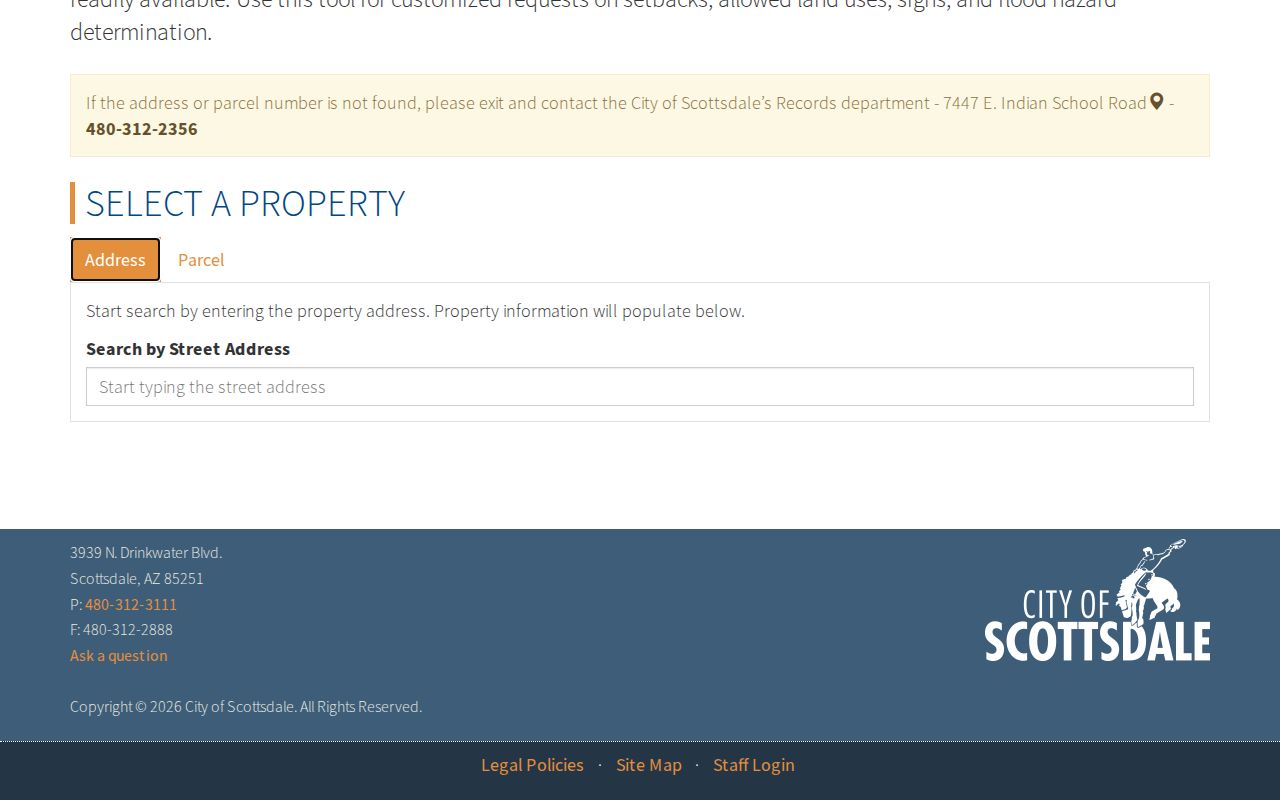
Its parcel, lot, QS, and MCR results supply the stable keys needed before moving into older records.
Trace Scottsdale Past-Owner Records
The Maricopa County Recorder index is the core of a backward address trail. The office reports a permanent public record since February 14, 1871, and its first deed on May 5 of that year. More than 52 million documents are searchable. That depth reaches well before Scottsdale's 1951 incorporation.
- Use the assessor's deed number to open the present owner's purchase instrument. If needed, search that owner as grantee near the displayed sale date.
- Read the deed for its seller, called the grantor, plus recording number, date, legal description, and return address.
- Search that seller as grantee in an earlier date range. Open the likely purchase deed and match its land description to the same Scottsdale parcel.
- Repeat from seller to seller. Try spouses, co-trustees, initials, trust names, and spelling variants when an index link breaks.
- When an estate appears, search the Maricopa County probate docket and return to the recorded distribution or later deed.
The web search also accepts recording number, recording date range, document type, book and page, and indexed legal-description terms. Not every field is complete on every old record. For a certified copy, an image absent from the portal, or help with a legacy citation, use the Recorder's office copy process or in-person access.
- Grantor and grantee
- The grantor gives an interest in land; the grantee receives it.
- Chain of title
- The linked sequence of recorded transfers affecting the same land.
- Legal description
- The formal land identity, often using lot, block, subdivision, or survey terms rather than a mail address.
- Criss-cross directory
- A directory section arranged by street and house number so an old address can lead to a listed name.
Note: A recorded transfer proves a property interest changed; it does not prove the grantee became a Scottsdale resident.
Keep Scottsdale Address Records Connected
Street wording is fragile. Directional prefixes, street types, unit labels, annexation, and postal practice can change or be copied in several forms. A Scottsdale mailing city may also describe land outside Scottsdale government. The 85254 area is a well-known example because much of it is municipally Phoenix. Far-north postal Scottsdale can extend toward county or unincorporated territory.
The lot, subdivision, MCR, plat, and APN are better continuity tools. A plat establishes the lot. The deed chain shows its owners. A county parcel map confirms where it lies. If the current parcel was split or combined, move between the old and new legal descriptions rather than forcing one modern number into every prior search. No verified citywide Scottsdale street-renumbering schedule was found, so a claimed renumbering date should not be invented.
Old Town research often benefits from early plats and the postwar newspaper. Planned communities such as McCormick Ranch or Gainey Ranch tend to turn on subdivision references. Northern tracts need a close city-limit check. The same backward method works in each place, but the most stable identifier changes with the development era.
Date Scottsdale Resident Homes with Permits
Ownership dates do not always date a structure. Scottsdale's Building Permit Search accepts permit number, street number, street name, subdivision, lot, owner or builder name, APN, and unit. The planning document search adds case, plan-check, civil-permit, parcel, full-text, and document-type fields. Site plans, certificates of occupancy, elevation certificates, and cases may be downloadable when posted.
A permit can mark construction, expansion, demolition, or a change tied to a named applicant. It may place an owner or builder at the address, but it is not an occupant list. Scottsdale Planning Records is also the fallback for a narrow request. Electronic delivery and in-person inspection are free; fewer than 25 standard black-and-white pages are free, while longer paper production follows the city's stated copy schedule.
Building plans have a local limit that matters for previous residents research. Scottsdale destroys them 180 days after completion or expiration, and the drawings remain designer intellectual property. Retained permit data, certificates, site plans, historic aerials, quarter-section maps, or the architect's own archive may do more for a late-twentieth-century house than an unverified Sanborn map.
Find Scottsdale Past Residents
Deeds name owners. Directories and census schedules can name people who actually appeared at an address, including some past residents who never held title. The Scottsdale Heritage Connection confirms residential and business directories, but its official web pages do not publish a full year-by-year run or publisher list. Ask staff to verify the target volume and whether it has a street or criss-cross section. Do not assume every year exists.
Use a simple date-pairing flow:
- Choose a deed or permit date that brackets the household question.
- Request the closest confirmed directory volume and inspect both its name and street sections.
- Transcribe the entry, abbreviation key, address, and edition year without filling gaps from memory.
- Check the editions just before and after it to bracket a listed arrival or departure.
- Compare the address or family with a released federal census through 1950, then test relationships in news, probate, and vital indexes.
Census records become public after 72 years, so 1950 is the latest released decennial schedule. A census may add household members, ages, birthplaces, and occupations. Directory and census evidence can still miss boarders, rural families, new annexations, unlisted people, and recently moved households. Treat each as a dated snapshot.
Request Scottsdale Resident Directory Evidence
The Scottsdale Heritage Connection occupies more than 2,000 square feet inside Civic Center Library. Its local holdings include directories, yearbooks, maps, microfilm and microfiche, bound newspapers, books, neighborhood newsletters, and vertical or ephemera files. Materials are used in the building. Some rare files need an Ask-a-Librarian appointment.
Use the Heritage Connection request channel to identify a directory or local file before traveling.
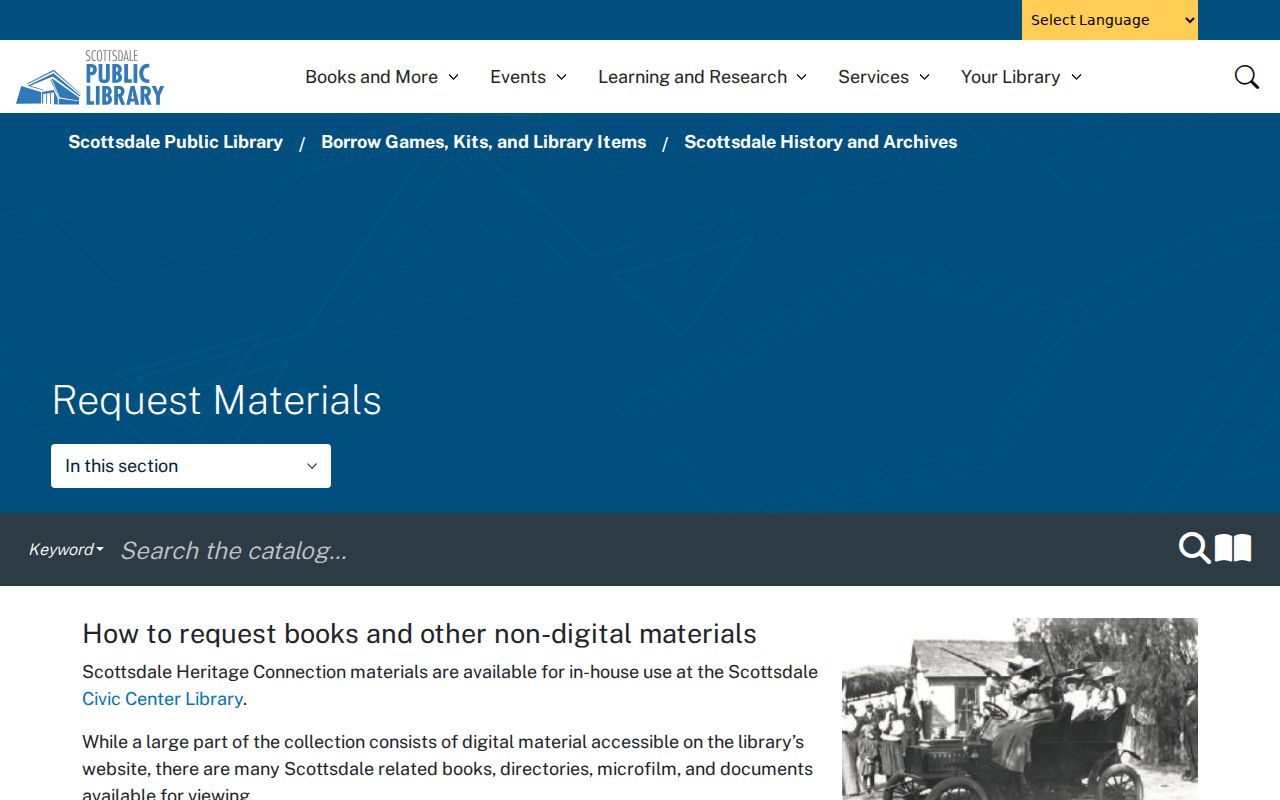
The request path is especially useful because exact Scottsdale directory years and publishers are not listed in a complete online inventory.
Every Scottsdale branch provides in-house access to Ancestry Library, while HeritageQuest offers census, directory, immigration, and genealogy sources under library authentication rules. The Scottsdale directory book page treats the collections themselves in depth. Address-history work should request only the volumes tied to the parcel's date range.
Extend Scottsdale Resident Record Trails
The digitized Scottsdale Progress run from 1948 through 1977 spans the years just before incorporation and the city's rapid postwar growth. Search it for address changes, property transfers, school news, clubs, obituaries, advertisements, and subdivision development. A newspaper mention can explain why a household disappears from one directory or why an estate enters the deed chain.
Obituaries can identify relatives and prior places. Probate files can establish an estate, personal representative, will, or court event connected with a transfer. The Clerk of the Superior Court in Maricopa County holds probate case materials, and its online docket can supply a first lead. If an older file or image is absent, use the clerk's records request or in-person channel. Marriages and divorces are also court records in Arizona, not state vital certificates.
For early family research, Arizona's public genealogy portal opens birth certificates after 75 years and death certificates after 50 years under A.R.S. § 36-351. Current certified records have eligibility and identity rules. A historical image can support a relationship in the trail, but the address should still be tied back to a deed, directory, census, or news item.
Note: Search the creating office and record group as well as the person's name when an Arizona archive index returns no result.
Compare Scottsdale Resident Address Records
Different sources prove different things. A Recorder instrument proves a recorded transfer. An assessor card describes the current tax parcel and may show sale history. A permit dates work. A directory gives a listed name at one edition date. A census records a household on its enumeration date. A newspaper or probate file explains life events. None should be made to carry another source's weight.
| Claim | Best starting proof | Useful check |
|---|---|---|
| Who owned the lot | Recorded deed and legal description | Assessor deed reference and plat |
| When the structure changed | City permit or certificate | Aerial, site plan, or news report |
| Who was listed at the address | Directory street or name entry | Census, newspaper, yearbook, or obituary |
| Why title passed through an estate | Probate case and recorded instrument | Death record or obituary |
Write down the record date, source, spelling, address form, and identifier for each find. Gaps are normal. A trust may interrupt the name chain. A rural tract may lack a directory entry. A later parcel split may require two legal descriptions. A careful blank is more accurate than a guessed past resident.
Protect Scottsdale Previous Residents
House history and family history are sound reasons to trace who lived here before. Living people still deserve care. Do not republish a compiled list of personal addresses, use an obituary to pressure a relative, or treat a protected person's absence as an invitation to search around the safeguard.
Arizona's Address Confidentiality Program provides qualifying survivors a substitute address, mail forwarding, and protected voter registration. Recorder images can also have protected identifiers redacted, and court files may be sealed or confidential. Current vital records have eligibility limits. Correct an error with the office that created the record, since later copies may draw from that source.
Lawful use. Trace Scottsdale previous residents for personal history, genealogy, or estate research. Never stalk, harass, threaten, or expose a protected person.